

Explore All Blogs | Insights on Smart Toilets & Bidets
Top Energy-Saving Bathroom Devices for Sustainable Homes
TL;DR:
- Upgrading to WaterSense-certified fixtures can significantly reduce water and energy use in bathrooms.
- Small, targeted device swaps, such as showerheads and flappers, often outperform full remodels in saving resources.
- DIY installation of efficient fixtures is generally feasible and offers quick payback with proper plumbing checks.
Upgrading your bathroom for sustainability sounds straightforward until you realize how many products claim to be eco-friendly while delivering little real savings. The truth is, not every low-flow label translates to meaningful results. Water heating accounts for roughly 18% of total home energy use, making the bathroom one of the highest-impact rooms to upgrade. The devices you choose and how well they match your existing plumbing determine whether you see real savings or just a smaller water stream. This guide cuts through the noise with research-backed recommendations to help you pick devices that genuinely deliver.
Table of Contents
- How to evaluate energy-saving bathroom devices
- Best devices for saving water and energy in the shower
- High-efficiency toilets: Flush less, save big
- Efficient faucets and smart fixtures
- Bonus upgrades: Bidets, smart toilets, and advanced controls
- Why small upgrades outperform “big renovations” for green bathrooms
- Finding devices and upgrades that fit your home
- Frequently asked questions
Key Takeaways
| Point | Details |
|---|---|
| Prioritize certified devices | Choose WaterSense or similarly labeled products to guarantee savings and performance. |
| Start with the shower and toilet | Upgrading these fixtures gives the fastest and biggest impact on your bills. |
| Check for easy fixes | Many leaks and inefficiencies can be solved with simple part replacements, not full upgrades. |
| Layer in smart solutions | Motion sensors and smart toilets add savings and comfort when you’re ready to upgrade further. |
How to evaluate energy-saving bathroom devices
Before you buy anything, you need a simple framework for judging whether a device will actually perform. Flow rate is the most important number to know. It tells you how many gallons per minute (gpm) or gallons per flush (gpf) a fixture uses, and lower almost always means less water and less energy spent heating it.
Here are the key criteria to weigh before purchasing:
- Flow rate against federal and WaterSense standards (1.5 gpm for faucets, 2.0 gpm for showers, 1.28 gpf for toilets)
- Certification labels such as WaterSense, which signals EPA-verified performance
- Pressure-balancing or mixing valves, especially if you are switching to low-flow fixtures in older homes
- Comfort and cleaning effectiveness, because a device that frustrates you will get replaced fast
- Compatibility with your existing plumbing, including pipe size and water pressure
One detail many homeowners overlook: low-flow devices can feel weak if your home’s water pressure is already on the low end. Low-flow showerheads save energy and prevent scalding when paired with proper mixing valves, but the valve quality matters as much as the fixture itself. For a deeper look at practical choices, check out these water-saving bathroom ideas that pair device selection with real home scenarios.
Pro Tip: Before purchasing any new shower or faucet fixture, ask a licensed plumber to confirm your home’s static water pressure. It should sit between 40 and 80 psi for most efficient fixtures to work as advertised.
Best devices for saving water and energy in the shower
Showers are the highest daily water energy user in most homes, outside of toilet flushing. Switching from a traditional showerhead (2.5 gpm) to a WaterSense-certified model (2.0 gpm or less) is one of the fastest-payback upgrades available.
Key things to know before you shop:
- Flow rate: Look for the WaterSense label, which confirms 2.0 gpm or less
- Aerator technology: Modern low-flow heads mix air into the stream for a full-pressure feel
- Pause buttons: Let you cut flow while soaping up without losing your temperature setting
- Adjustable spray patterns: Useful for households with different pressure preferences
Replacing a standard showerhead with a WaterSense model can save up to $200/year for a family of four — without sacrificing shower time.
The pressure concern is real but solvable. Top low-flow models match full-flow pressure and coverage, according to Consumer Reports testing. The trick is buying a quality aerator-equipped model rather than the cheapest option on the shelf.
| Model type | Flow rate (gpm) | Pressure feel | Avg. annual savings |
|---|---|---|---|
| Standard showerhead | 2.5 | Full | Baseline |
| WaterSense (basic) | 2.0 | Good | ~$70 |
| WaterSense (aerator) | 1.75 | Excellent | ~$130 |
| High-efficiency (1.5 gpm) | 1.5 | Strong | ~$200 |
For households ready to go further, explore shower energy-saving tips paired with smart controls, or browse energy-saving shower packages that bundle fixtures with compatible valves.
Pro Tip: Test your current water pressure with an inexpensive gauge before upgrading. If pressure reads below 45 psi, choose a model rated for lower-pressure homes to keep your shower comfortable.
High-efficiency toilets: Flush less, save big
Toilets are the single largest source of water use inside most American homes. Older models can use anywhere from 3.5 to 7 gallons per flush (gpf). A modern high-efficiency toilet (HET) uses just 1.28 gpf or less, cutting usage nearly in half compared to models from the 1990s and accounting for roughly 30% of total household water consumption.
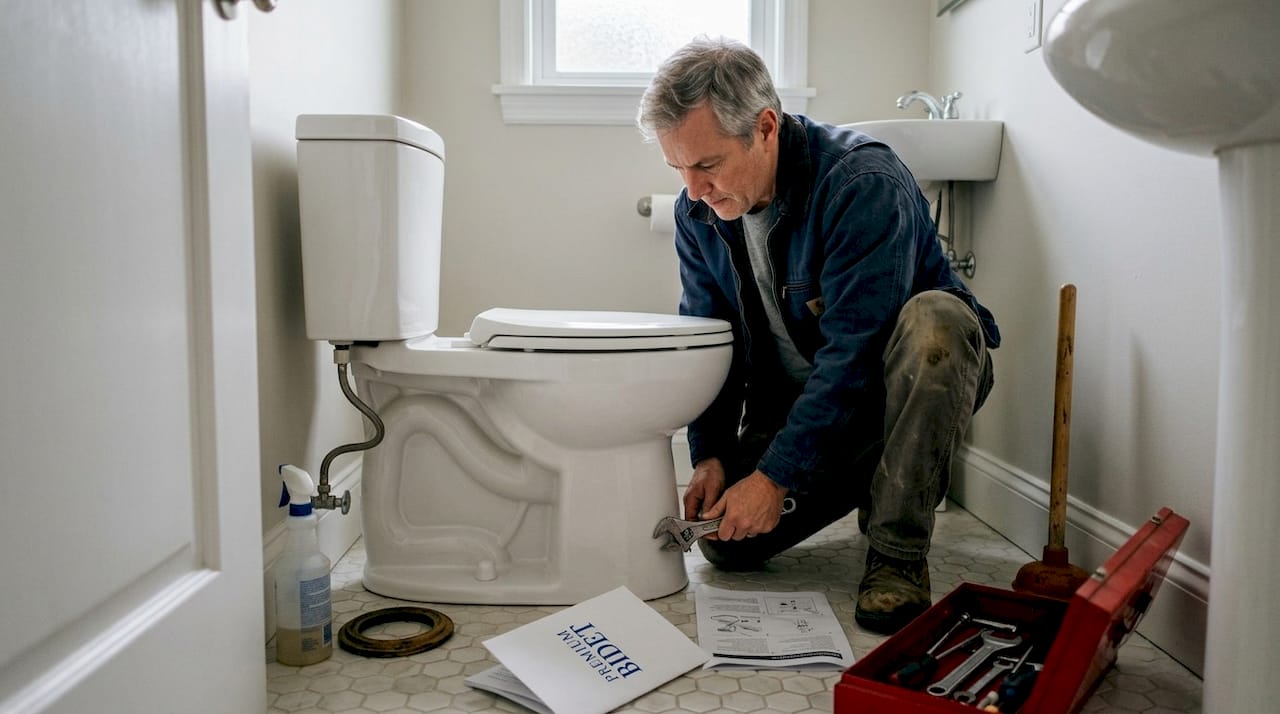
Dual-flush toilets add even more flexibility. They offer a light flush (0.8 gpf) for liquid waste and a full flush (1.28 gpf) for solid waste, giving you maximum control over daily water use.
Features to prioritize when shopping:
- WaterSense certification for independently verified performance
- MaP flush score of 500g or higher to confirm cleaning power
- Easy installation with standard 12-inch rough-in dimensions
- Quiet-close seat for everyday comfort
- Leak detection indicators built into the fill valve
One big water waster hiding in plain sight: a running toilet. Running toilets waste up to 21,000 gallons per month, according to EPA experts. Before replacing the whole unit, check the flapper and fill valve. These parts cost under $15 and often solve the problem.
| Toilet type | Gallons per flush | Estimated annual cost | Ease of install |
|---|---|---|---|
| Traditional (3.5 gpf) | 3.5 | High | Easy |
| High-efficiency (1.28 gpf) | 1.28 | Moderate | Easy |
| Dual-flush (0.8/1.28 gpf) | 0.8 or 1.28 | Low | Moderate |
For a full breakdown of options, browse toilet water efficiency solutions or explore eco-friendly toilet upgrades. If you are weighing a bidet addition, the bidet versus toilet water usage comparison is worth reading first.
Pro Tip: Replace flappers and fill valves every three to five years as routine maintenance. It costs almost nothing and prevents the silent water loss that quietly inflates your bill.
Efficient faucets and smart fixtures
Faucets are often the last thing homeowners think about upgrading, but they run constantly throughout the day. The federal standard sits at 2.2 gpm, while WaterSense-certified faucets operate at 1.5 gpm or less, reducing water use by 32% compared to standard models. That adds up quickly across multiple sinks.
Motion-sensor faucets take savings a step further by eliminating drips and accidental runs. They also reduce touchpoints, which is a genuine hygiene benefit. Smart fixtures with integrated on-demand water heaters go even further, eliminating the cold-water wait and reducing energy wasted during heat-up time.
Key stats at a glance:
WaterSense faucets deliver 32% water savings without noticeable performance loss.
Upgrades worth considering:
- Aerator inserts (under $10 at any hardware store) that drop flow to 1.0 or 1.5 gpm
- Motion-sensor faucets for kids’ bathrooms where taps are often left running
- Thermostatic mixing valves to set max water temperature and cut heating energy
- Point-of-use water heaters mounted under the sink to eliminate waiting for hot water
- Smart faucet timers for households tracking water budgets
For energy-efficient faucet options ranked by flow rate and user ratings, the variety is wider than most people expect. You can also explore water efficiency tips for additional context on where faucet waste tends to sneak in.
Pro Tip: Swap out aerators before spending money on full faucet replacements. A $7 aerator insert can cut flow by 30% or more and takes about two minutes to install.
Bonus upgrades: Bidets, smart toilets, and advanced controls
Once you have handled the core fixtures, the next level of savings comes from smart and integrated devices. Bidet seats are one of the most overlooked upgrades for both sustainability and comfort. They dramatically reduce toilet paper use, which is not just a cost saving but a meaningful reduction in production-related resource use.
Smart toilets bring in automatic flushing, built-in leak detection, night lighting, and even seat warming, all controlled with precision to avoid waste. Smart upgrades enhance hygiene while cutting water and energy consumption when features like auto-off and eco-flush modes are active.
High-impact bonus options to explore:
- Bidet seats with adjustable water pressure, temperature, and air drying
- Smart toilets with eco-flush and seat sensor to prevent unnecessary flushing
- App-controlled shower systems with temperature memory to eliminate warm-up waste
- Leak detection devices that send alerts to your phone when drips are detected
- Wi-Fi-connected water monitors that track consumption by fixture
For energy-saving bidet solutions that pair hygiene with sustainability, there are options for every budget. For those ready to go fully smart, the modern toilet upgrades guide covers the full spectrum. You can also look into smart fixture ideas for layout and integration planning.
Pro Tip: Many utility companies and municipalities offer rebates on WaterSense and smart bathroom devices. Search your zip code on the EPA’s rebate finder before purchasing to reduce your out-of-pocket cost significantly.
Why small upgrades outperform “big renovations” for green bathrooms
Here is something the renovation industry rarely says out loud: a full bathroom gut-job often delivers worse environmental payback than a series of smart, targeted device swaps. Full remodels discard materials, require weeks of contractor time, and may not touch the actual fixtures driving your water and energy bills.
Swapping a showerhead takes fifteen minutes. Replacing a flapper takes five. Installing a bidet seat takes under an hour. These changes start saving money on your next utility bill. A full renovation might take years to pay back its own cost in savings, if it ever does.
The smartest approach we have seen: tackle one fixture category per quarter. Start with the shower, then the toilet fill valve, then faucet aerators. By the end of a year, you have transformed the bathroom’s efficiency without touching the tile or the vanity.
Proper plumbing checks still matter for any installation. But most of these upgrades are genuinely DIY-friendly. The myth is that meaningful green progress requires a big project. The reality, backed by data on eco-conscious bathroom trends, is that incremental changes add up faster than any single renovation ever could.
Finding devices and upgrades that fit your home
Ready to put these upgrades into action? At PremiumBidet.com, we have done the selection work for you. Every product in our catalog is vetted for efficiency, comfort, and compatibility with standard U.S. plumbing.
Start with our bidet toilet seats for an immediate comfort and sustainability upgrade, or explore our bidet-toilets combos if you want an all-in-one smart solution. Both categories include WaterSense-eligible and rebate-qualifying options from trusted brands like TOTO, Bio Bidet, and Swiss Madison. For a broader look at what is available, browse more bathroom upgrades across every fixture category. U.S.-based support, fast shipping, and warranty coverage are included with every order.
Frequently asked questions
How much can I actually save by switching to low-flow bathroom devices?
Switching to WaterSense-certified showerheads and toilets can save a family of four up to $200 per year. Adding efficient faucets and a bidet seat can push those savings even higher over time.
Is it difficult to retrofit older bathrooms with energy-saving fixtures?
Most modern efficient fixtures are designed for standard DIY installation, but you should confirm your home has pressure-balancing valves and compatible pipe sizing before swapping fixtures in older homes.
Are energy-saving bathroom devices as comfortable as traditional fixtures?
Yes. Top-rated low-flow models tested by Consumer Reports match the pressure and spray coverage of standard fixtures, largely because of advanced aerator technology built into the showerhead.
How do I know if my faucet or toilet needs replacing versus a simple repair?
Start with the basics: check flappers and fill valves before committing to a full replacement. A $10 part swap often eliminates the leak entirely and restores full efficiency without any new installation.
Recommended
- Water-saving bathroom ideas for eco-friendly homes– Smart Toilets & Bidet Seats | Premium Bidet
- Energy-saving bidets: health, savings & sustainability– Smart Toilets & Bidet Seats | Premium Bidet
- Boost Toilet Water Efficiency: Eco-Friendly Home Solutions– Smart Toilets & Bidet Seats | Premium Bidet
- Advantages of eco-conscious bathrooms in 2026– Smart Toilets & Bidet Seats | Premium Bidet
- What Are Eco-Friendly Materials? 15 Sustainable Examples – SLY Collective Underwear
Leave a comment